


Geiger Intersects Multiple Mineralized Intervals at ACKIO, Including 11,491 cps at the Hook Project, Saskatchewan
MWN-AI** Summary
Geiger Energy Corp. (TSXV: BEEP) has reported significant progress from its 2026 winter drilling program at the ACKIO prospect within its 100% owned Hook Project in the Athabasca Basin, Saskatchewan. The latest drilling has resulted in the discovery of multiple mineralized intervals, highlighting the strong potential for resource expansion.
Key highlights include the intersection of three mineralized zones in drill hole AK26-148. Notably, new uranium mineralization was found at a depth of 80 meters, supporting the expansion of the upper lens. Meanwhile, a high-grade lens encountered at 186 meters reached a peak count of 11,491 counts per second (cps), with an average of 2,291 cps across the interval of 186.6 to 208.4 meters. The overall high-grade lens extends over 10.1 meters with an impressive average of 3,768 cps. These results affirm the continuity of mineralization across multiple pods, indicating a broader mineralized system within the area.
Rebecca Hunter, President and CEO of Geiger, stated that the drilling results underscore the scale and continuity of the mineralization, while also supporting the interpretation of expansive growth potential at ACKIO. The southern extension of the drilling has confirmed continuity in pods 3, 4, and 5, thereby encouraging future exploration along the fertile trend.
The Hook Project has thus far seen approximately 1,700 meters of drilling, with efforts focused on enhancing understanding of the mineral pods concentrated in both the upper and lower segments of ACKIO. As the final holes for this drill program approach, the company anticipates uncovering further mineralized zones, reinforcing Geiger's commitment to uncovering high-grade uranium deposits in this prospective region.
MWN-AI** Analysis
Geiger Energy Corp. (TSXV: BEEP) has recently announced significant progress in its exploration efforts at the ACKIO prospect within the Hook Project, located in the highly prospective Athabasca Basin, Saskatchewan. The company reported three mineralized zones from drill hole AK26-148, with exceptional radiometric counts, including a staggering peak of 11,491 counts per second (cps). Such high-grade intersections, coupled with substantial average counts, should strengthen investor interest and boost share performance.
The continuous discovery of mineralization, particularly at various depths, reinforces the prospectivity of this area. The confirmation of continuity south of the ACKIO prospect via identified pods 3, 4, and 5 indicates a broader and structurally-controlled mineralized system, with the potential for further expansion along strike, which is a positive signal for operational scalability.
As drilling progresses, the focus on high-grade lenses adds to the excitement among investors who value high-quality uranium deposits. The mining sector's increasing demand for uranium, driven by a global push for clean energy, may propel Geiger's stock value upward if these drilling results substantiate a resource upgrade.
Investors should monitor upcoming assay results for validation of the current findings, as well as further drill results from the final holes of the 2026 winter program. The geological indicators suggest strong potential for further high-grade discoveries, making Geiger an attractive prospect. However, caution is advised due to inherent risks in mining exploration.
In summary, Geiger's ongoing exploration at the ACKIO prospect provides an opportune moment for investors looking to capitalize on the burgeoning uranium market, albeit while remaining mindful of the volatile nature of the sector.
**MWN-AI Summary and Analysis is based on asking OpenAI to summarize and analyze this news release.
Key Highlights
- Three mineralized zones intersected in AK26-148
- New mineralization at 80 m supports upper-lens expansion, while the high-grade lens at 186 m strengthens lower-lens grade potential
- Maximum counts up to 11,491 cps using a Triple Gamma Probe at 202 m in 10 m high-grade lens
- Continuity confirmed to the south in pods 3, 4 and 5
- Mineralization remains open along strike, supporting further expansion potential
Toronto, Ontario--(Newsfile Corp. - March 31, 2026) - Geiger Energy Corp. (TSXV: BEEP) (OTCQB: BSENF) ("Geiger") or the ("Company") is pleased to provide an update from its ongoing 2026 winter program at the ACKIO prospect on its 100% owned Hook Project in the Athabasca Basin, Saskatchewan (Figure 1 & Figure 2).
"A new uranium mineralization intersection at south ACKIO, shows the prospectivity of this area for real upgrade and expansion potential. These results continue to demonstrate the scale and continuity across multiple pods and support our interpretation of a broader mineralized system at ACKIO. The final holes for the 2026 winter drill program will test for additional zones farther south along the broader fertile trend," said Rebecca Hunter President & CEO of Geiger.
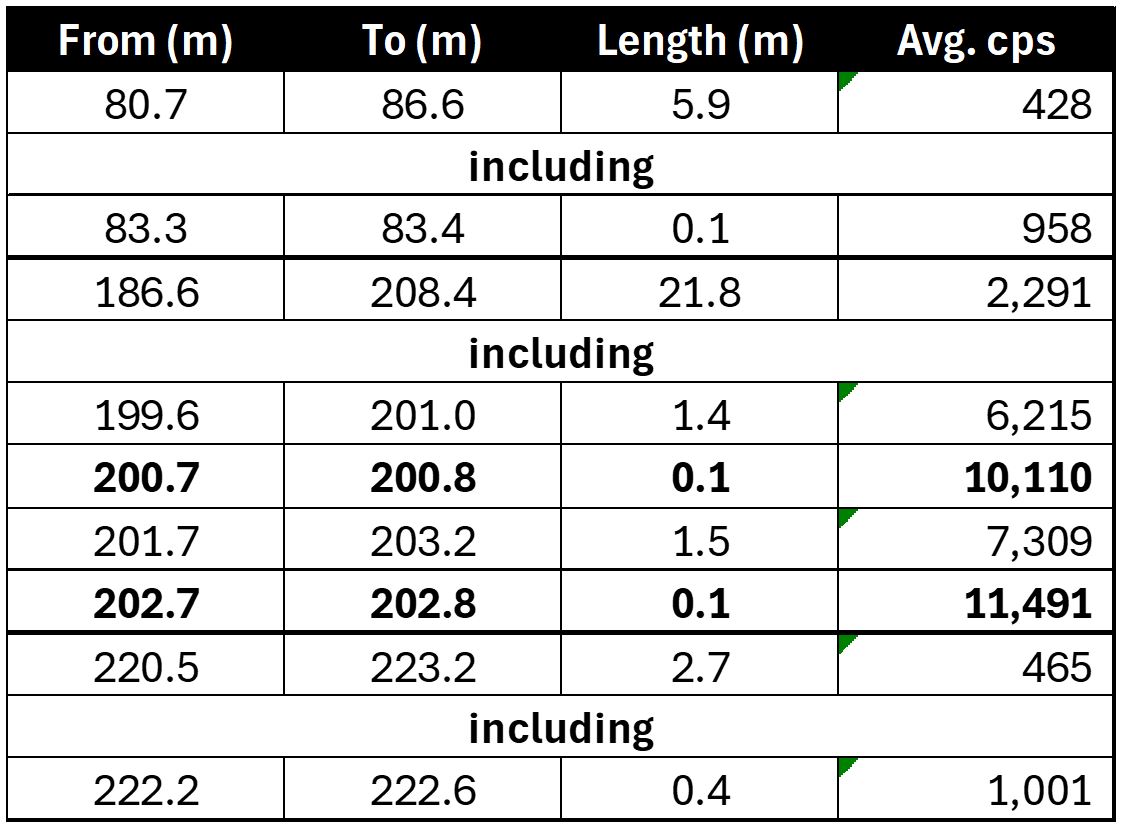
The drilling at the southern extent of ACKIO has extended and upgraded mineralization in the upper pod 3 and the lower pods 4 and 5, supporting continuity within the structurally-controlled system. AK26-148 intersected mineralization within discreet fault and alteration zones from 80.7 to 86.6 m with counts averaging 428 cps and a maximum of 958 cps and at 186.6 m to 208.4 m, with counts averaging 2,291 cps, with a high of 11,491 cps at 202 m. The highest grade lens is 10.1 m (197.2 m to 207.3 m), averaging 3,768 cps. New mineralization was intersected at 80 m, indicating continued and expanded potential for the upper lenses, and the high-grade lens at 186 m shows increased grade potential for the lower lenses.
- Figure 1: Geiger projects location map in the Athabasca Basin. The ACKIO prospect is identified with a red circle.
- Figure 2: ACKIO prospect area with 2026 drill holes, proposed drill holes with the historical drillholes.
- Figure 3: Highest grades intersected in AK26-148 intersecting extension of pods 4 and 5 at the ACKIO prospect at around 190 to 205 m. Radiometric counts (cps) are presented on the box from a hand-held CT-007 scintilometer.
- Figure 4: 2026 proposed drill target areas.
- Figure 5: Target areas at the ACKIO prospect overlain on a Total Magnetic Intensity magnetic map and a 30 Hz ZTEM conductivity anomaly, which is closely associated with the mineralization in the ACKIO area.
ACKIO Mineralization
The continuation of the 2026 program targeted mineralization pods 3, 4 and 5, which occur within structurally controlled zones marked by strong brecciation and alteration, including hematite, chlorite and sulphides, hosted in variable calc-silicate and calc-pelite rocks. Localized desilicification and albitization are observed near higher-grade intervals and appear to be associated with stronger radiometric responses.
In drill hole AK26-148, mineralization was intersected in three main zones (Table 1):
- 5.9 m averaging 428 cps; maximum of 958 cps (80.7 m to 86.6 m)
- 21.8 m averaging 2,291 cps; maximum 11,491 cps (186.6 m to 208.4 m) (Figure 3)
- 2.7 m averaging 465 cps; maximum 1,001 cps (220.5 m to 222.6 m)
To view an enhanced version of this graphic, please visit:
https://images.newsfilecorp.com/files/6412/290621_geigertableimg.jpg
Table 1: Radiometric down hole probe results for AK26-148.
AK26-148 was drilled at a 266° azimuth and -55° dip.
All drill core is scanned with a CT-007 handheld spectrometer by GammaGuard to check for radioactivity. Intervals of anomalous radioactivity are removed and measured outside the box in an area of background radioactivity. Drill holes are also surveyed using a 2GHF-1000 Triple Gamma Probe with a Mount Sopris Matrix Logging Console and Mount Sopris 4MXA 500 or 1000 m winch at 0.1 metre intervals. Mount Sopris' 2GHF-1000 downhole triple-gamma probe utilizes a sodium iodine (Nal) crystal to detect changes in natural radioactivity for concentrations of uranium, thorium and potassium from gamma rays emitted from the rock formations. The probe uses a Nal crystal, and two Geiger Mueller tubes which allows the instrument to conduct precise Natural Gamma measurements that range from 0.1% to 20% concentrations of U3O8 in radioactive zones. Downhole probe results are used to compare with handheld scintillometer results to verify the depth and strength of radioactive intervals and to assess radioactivity through sections of lost core. The downhole radiometric probe results using the NaI values are presented in this news release. Measurements of total gamma on drill core or from the down hole probe are an indication of uranium content but may not correlate with chemical assays. Assay samples will be submitted for chemical analysis and will be presented in the coming months.
Hook Project Overview
Approximately 1,700 metres have been completed to date at the Hook Project, with drilling focused thus far on ACKIO, TT and Tab areas (Figure 4).
At ACKIO (Figure 5), the current program is designed to expand high-grade Pod 1 and Pod 7, test approximately 500 metres of strike for additional mineralized zones, and evaluate southern and eastern extensions along the broader structural corridor. In AK26-148, we are testing Pods 3, 4 and 5, which are continuations of the upper and lower main lenses of the ACKIO mineralization.
In the TT area, located 5.5 kilometres southwest of ACKIO, drilling is designed to follow up on strong historical clay alteration ranging from 30 to 145 metres in thickness, test beneath the alteration zone for the underlying mineralized system, and evaluate along-strike potential within a coincident gravity-low and magnetic-low corridor.
In the TAB area, located approximately 5 km northeast of ACKIO, drilling is focused on testing the western edge of a strong ZTEM conductivity anomaly in conjunction with a gravity low anomaly, which has a similar geophysical footprint to the ACKIO discovery area.
About Geiger
Geiger controls approximately 390,000 hectares in Saskatchewan's Athabasca Basin and 95,519 hectares in Nunavut's Thelon Basin, two of the world's most prospective uranium districts. The Company is focused on discovering high-grade uranium deposits across both regions.
Geiger's flagship asset, the Aberdeen Project (Thelon Basin), hosts the high-grade Tatiggaq and Qavvik discoveries. Tatiggaq is a basement-hosted system defined over a 300-metre strike length, with multiple steeply dipping mineralized lenses between 80 and 180 metres depth. The system remains open over a 1.5 km strike length and at depth. Qavvik is a similarly styled basement-hosted discovery extending from surface to ~400 metres depth, open over 500 metres and at depth.
The Aberdeen Project hosts 50+ high-priority targets, many showing strong alteration and anomalous uranium from limited historical drilling, with several areas remaining completely untested.
In the Athabasca Basin, Geiger is advancing the Hook Project, which hosts the ACKIO near-surface uranium discovery. ACKIO extends over 375 metres along strike and 150 metres in width, with at least nine distinct uranium pods starting at 28 metres depth and continuing to approximately 300 metres. The system remains open in multiple directions. The Hook Project also contains large clay-alteration systems with elevated radioactivity, highlighting additional discovery potential beyond ACKIO.
Qualified Person Statement
The technical information contained in this news release has been reviewed and approved by Rebecca Hunter, P.Geo, President & CEO of Geiger Energy Corp., a Qualified ?Person, as defined in "National Instrument 43-101, Standards of Disclosure for Mineral Projects." ?
For More Information
"Rebecca Hunter"
Geiger Energy Corp.
Rebecca Hunter, Ph.D. P.Geo.
CEO, President & Director
Email: info@geigerenergy.com
Phone: 416-644-1567
Cautionary Statement
Certain information in this news release is considered forward-looking within the meaning of certain securities laws and is subject to important risks, uncertainties and assumptions. This forward-looking information includes, among other things, information with respect to Geiger's beliefs, plans, expectations, anticipations, estimates and intentions. The words "may", "could", "should", "would", "suspect", "outlook", "believe", "anticipate", "estimate", "expect", "intend", "plan", "target" and similar words and expressions are used to identify forward-looking information. The forward-looking information in this news release describes Geiger's expectations as of the date of this news release.
The results or events anticipated or predicted in such forward-looking information may differ materially from actual results or events. Material factors which could cause actual results or events to differ materially from such forward-looking information include, among others, risks arising from general economic conditions; adverse industry events; inability to realize anticipated synergies; future legislative and regulatory developments; inability to access sufficient capital from internal and external sources, and/or inability to access sufficient capital on favourable terms; income tax and regulatory matters; the ability of Geiger to implement its business strategies; competition; currency and interest rate fluctuations and other risks. Readers are cautioned that the foregoing list is not exhaustive.
Geiger cautions that the foregoing list of material factors is not exhaustive. When relying on forward-looking information to make decisions, investors and others should carefully consider the foregoing factors and other uncertainties and potential events. Geiger has assumed a certain progression, which may not be realized. It has also assumed that the material factors referred to in the previous paragraph will not cause such forward-looking information to differ materially from actual results or events. However, the list of these factors is not exhaustive and is subject to change and there can be no assurance that such assumptions will reflect the actual outcome of such items or factors.
THE FORWARD-LOOKING INFORMATION CONTAINED IN THIS NEWS RELEASE REPRESENTS THE EXPECTATIONS OF GEIGER AS OF THE DATE OF THIS NEWS RELEASE AND, ACCORDINGLY, IS SUBJECT TO CHANGE AFTER SUCH DATE. READERS SHOULD NOT PLACE UNDUE IMPORTANCE ON FORWARD-LOOKING INFORMATION AND SHOULD NOT RELY UPON THIS INFORMATION AS OF ANY OTHER DATE. WHILE GEIGER MAY ELECT TO, IT DOES NOT UNDERTAKE TO UPDATE THIS INFORMATION AT ANY PARTICULAR TIME.
Neither the TSXV nor its Regulation Services Provider (as that term is defined in the policies of the TSXV) accepts responsibility for the adequacy or accuracy of this release.
To view the source version of this press release, please visit https://www.newsfilecorp.com/release/290621
FAQ**
Can Geiger Energy Corp. BSENF elaborate on the significance of the 80 m new mineralization intersection in drill hole AK26-148 and how it impacts the potential for upper-lens expansion?
How does the high count of 11,491 cps at 202 m in AK26-148 compare to previous results, and what implications does this have for the overall grade potential of the lower lenses in the ACKIO prospect?
What specific strategies does Geiger Energy Corp. BSENF plan to employ in order to further explore the open mineralization along strike identified in drill holes at the ACKIO prospect?
Given the continuity confirmed to the south in pods 3, and 5, what are Geiger's expectations for future drilling results in enhancing the overall resource assessment at the Hook Project?
**MWN-AI FAQ is based on asking OpenAI questions about Geiger Energy Corp. (OTC: BSENF).
NASDAQ: BSENF
BSENF Trading
-2.56% G/L:
$0.19 Last:
6,525 Volume:
$0.2022 Open: