






Atlas Critical Minerals Reports Strong Initial Rare Earth and Titanium Results from Alto do Paranaiba Project
MWN-AI** Summary
Atlas Critical Minerals Corporation has announced promising initial results from its Alto do Paranaíba Project in Brazil, revealing strong potential for rare earth and titanium mineralization. The project spans over 25,000 hectares in Minas Gerais, characterized by the Mata da Corda geological sequence, which includes sedimentary and volcanic formations known for their mineral-rich deposits. The results are supported by SGS Canada’s technical reports, ensuring the validity of the findings.
The Company conducted an extensive surface sampling campaign over three exploration blocks, yielding exceptional grades. Noteworthy highlights include a peak of 28,870 ppm Total Rare Earth Oxides (TREO) and 23.2% Titanium Dioxide (TiO2) in one sample from Block 3. Across all blocks, TREO grades consistently surpassed 1,500 ppm, showcasing the area's favorable mineralization conditions.
Further, an initial auger drilling campaign of 11 drillholes complemented the surface samples, confirming high-grade near-surface mineralization. Significant drill results include 5,961 ppm TREO with 1,690 ppm Magnetic Rare Earth Oxides (MREO) and 13.3% TiO2 over a 12-meter intercept (DHTI-001). The mineralization is positively correlated, indicating a robust geological model conducive to future exploration.
Atlas Critical Minerals operates a broad portfolio of critical mineral rights in Brazil, emphasizing its strategic role in supplying essential materials for electrification and defense applications. The Company remains committed to further exploring and developing these high-potential resources, positioning itself as a key player in the critical minerals sector. The positive initial reports could attract investor interest and pave the way for future advancements in the project.
MWN-AI** Analysis
Atlas Critical Minerals Corporation (OTCQB: JUPGF) has announced promising initial results from its Alto do Paranaíba Project in Brazil, showcasing significant rare earth element (REE) and titanium mineralization. The standout results, including surface sample grades reaching 28,870 ppm Total Rare Earth Oxides (TREO) and 23.2% titanium dioxide (TiO2), suggest a highly prospective project that could potentially be a major player in the global critical minerals market.
The encouraging results from all three exploration blocks indicate not only robust near-surface mineralization but also the geological advantages presented by the Mata da Corda Group. This combination of geological setting and mineral grades may attract interest from investors and industry players looking for reliable sources of REEs and titanium, both of which are pivotal in various tech applications and clean energy technologies.
Investors should consider a few critical factors when evaluating Atlas Critical Minerals. Firstly, the company's strategy in ongoing exploration and development activities will be paramount. With extensive mineral rights (over 25,000 hectares), the project’s exploration potential appears promising, but successful expansion and profitability hinge on effective execution of further drilling and environmental assessments.
Secondly, monitoring market demand for REEs and titanium, particularly as attention grows on sustainable practices and the electrification of various industries, can provide insights into potential share price movements. The emphasis on reducing reliance on traditional energy sources will likely keep critical minerals in high demand.
Lastly, potential risks inherent in mining operations, geopolitical stability in Brazil, and regulatory complexities should be analyzed. While the current phase holds promise, investors should assess the volatility and uncertainties typical of the mineral exploration sector.
In conclusion, Atlas Critical Minerals presents a potentially rewarding investment opportunity, especially for those interested in the sustainable energy transition, but thorough due diligence is essential before committing capital.
**MWN-AI Summary and Analysis is based on asking OpenAI to summarize and analyze this news release.
Observed Surface Sample Grades up to 28,870ppm TREO and 23.2% TiO2
Belo Horizonte, Brazil--(Newsfile Corp. - July 17, 2025) - Atlas Critical Minerals Corporation (OTCQB: JUPGF) ("Atlas Critical Minerals" or the "Company") is pleased to report strong initial rare earth and titanium results from its Alto do Paranaíba Project (the "Project"), located in the western part of state of Minas Gerais, Brazil. The project demonstrates significant potential for near-surface rare earth and titanium mineralization within the "Mata da Corda" Group geological sequence. SGS Canada, Inc. ("SGS") was retained to prepare technical reports under U.S. Regulation S-K 1300. In particular, Marc-Antoine Laporte and Yann Camus from SGS are Qualified Persons for the Project. SGS is well-known as a global leader in testing, inspection and certification of mineral properties and projects.
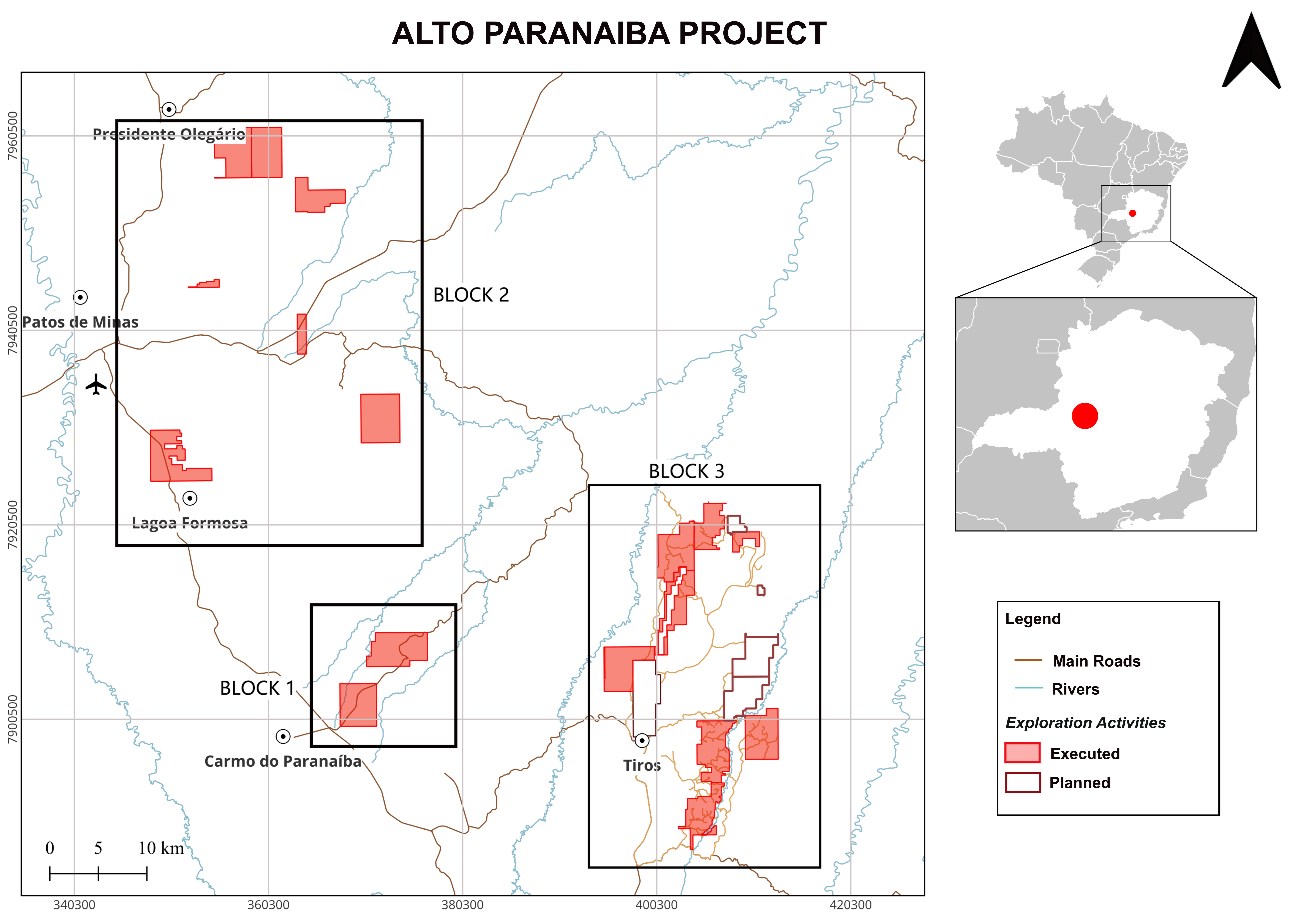
The Project comprises mineral rights totaling more than 25,000 hectares, strategically positioned within a major volcano-sedimentary geological sequence. The extensive Project area has been divided into three exploration blocks for ease of exploration activities as shown in Figure 1.
Figure 1 - Exploration Blocks of the Alto do Paranaíba Project
To view an enhanced version of this graphic, please visit:
https://images.newsfilecorp.com/files/6728/259070_cdd7d2d8b4778ada_002full.jpg
The Mata da Corda Group consists of the sedimentary Capacete Formation crosscut by the volcanic Patos Formation. This geological setting, with its geochemical signature confirmed to be related to Brazilian late Cretaceous Alkaline Provinces, provides outstanding exploration potential for mineralization for both rare earth elements and titanium.
Surface Sampling Results
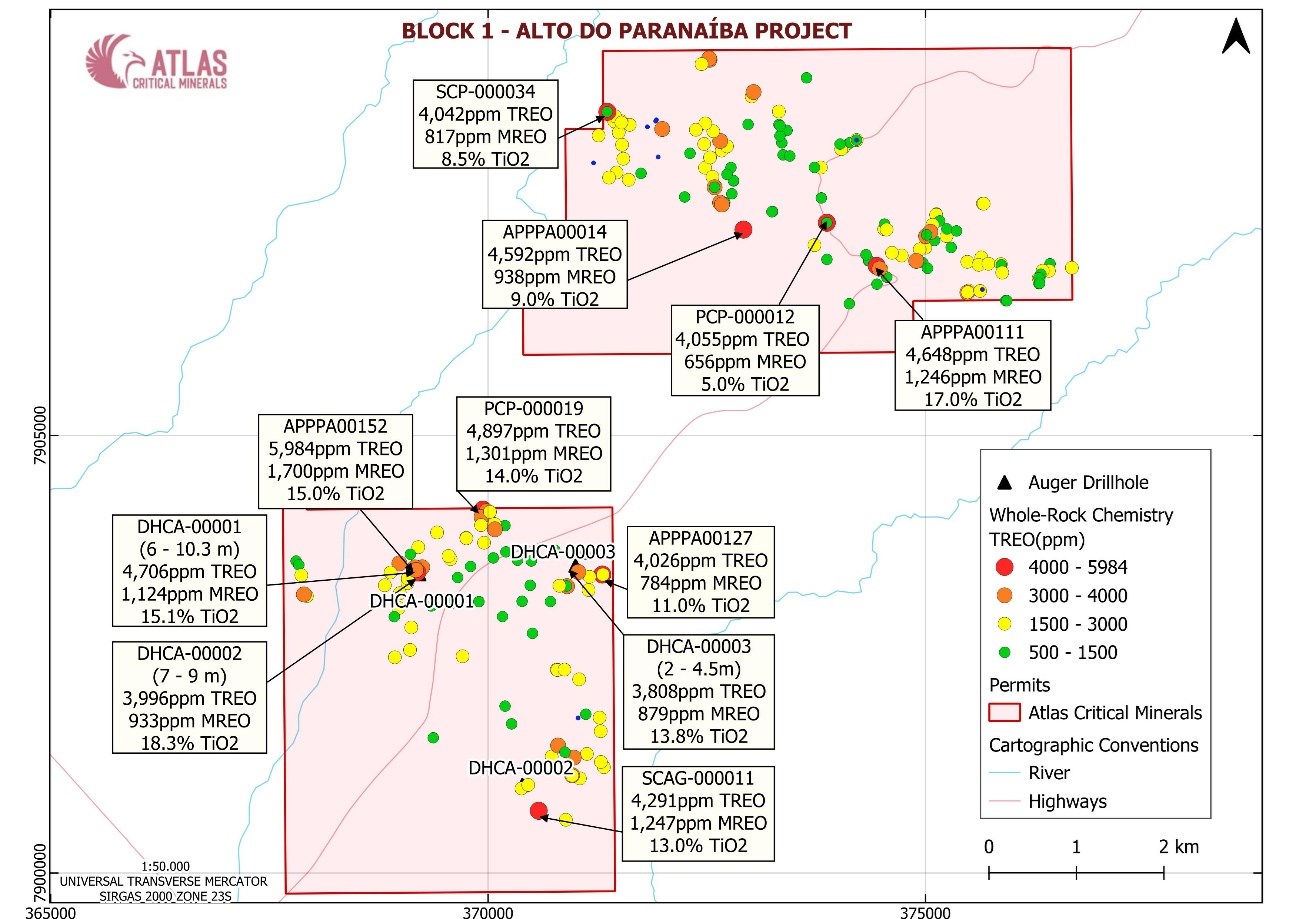
The Company's initial exploration campaign has included 770 surface samples (rock and soil), which demonstrated consistently high grades across all three blocks:
Block 1 Highlights:
- 5,984 ppm TREO; 1,700 ppm MREO; 14.8% TiO2 (Sample APPPA00152)
- 4,897 ppm TREO; 1,301 ppm MREO; 13.9% TiO2 (Sample PCP-000019)
- 4,648 ppm TREO; 1,246 ppm MREO; 17.4% TiO2 (Sample APPPA00111)
Figure 2 - Block 1 Surface Sampling Results Map Indicating Widespread High-Grade TREO Mineralization (>1,500ppm)
To view an enhanced version of this graphic, please visit:
https://images.newsfilecorp.com/files/6728/259070_cdd7d2d8b4778ada_003full.jpg
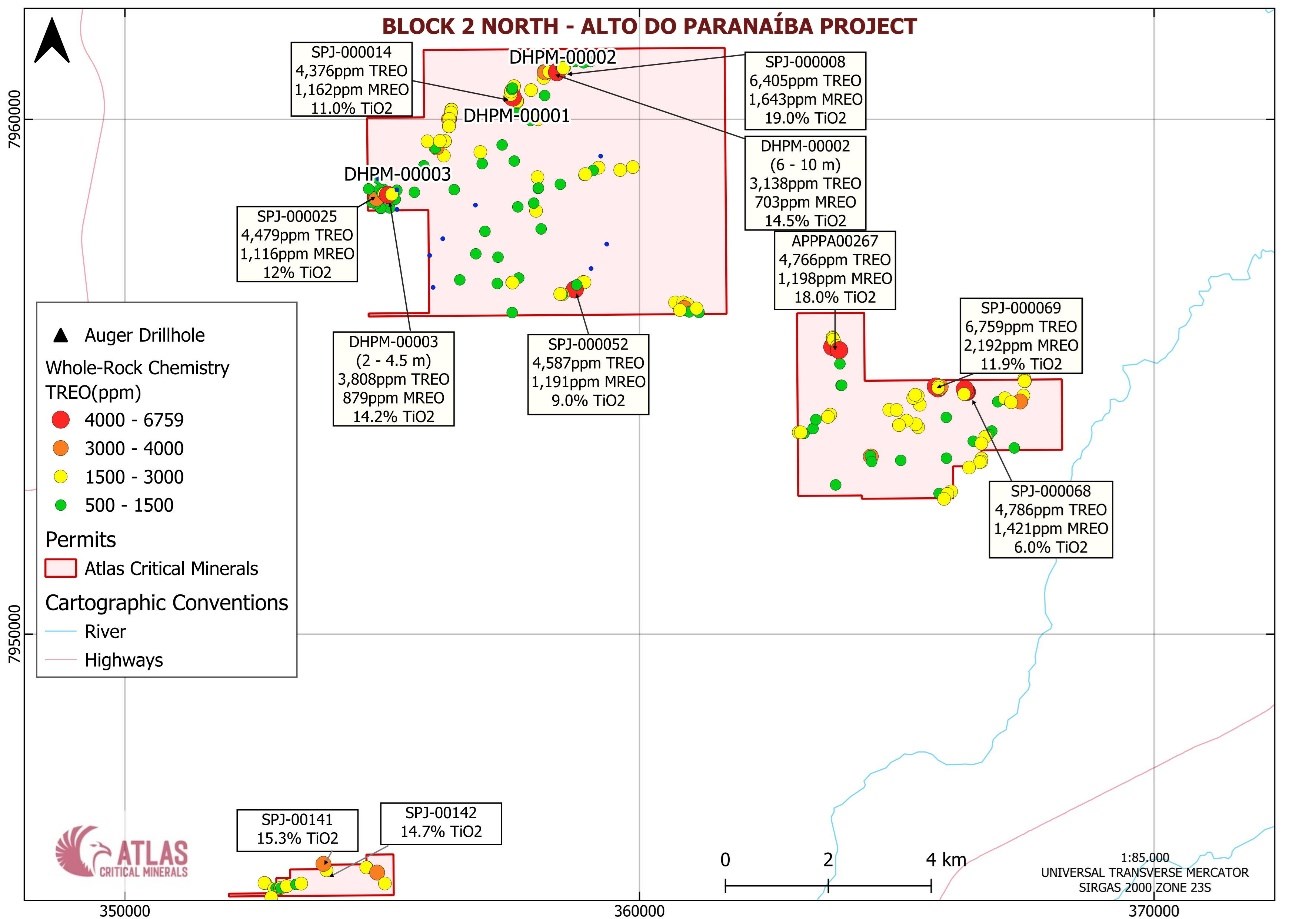
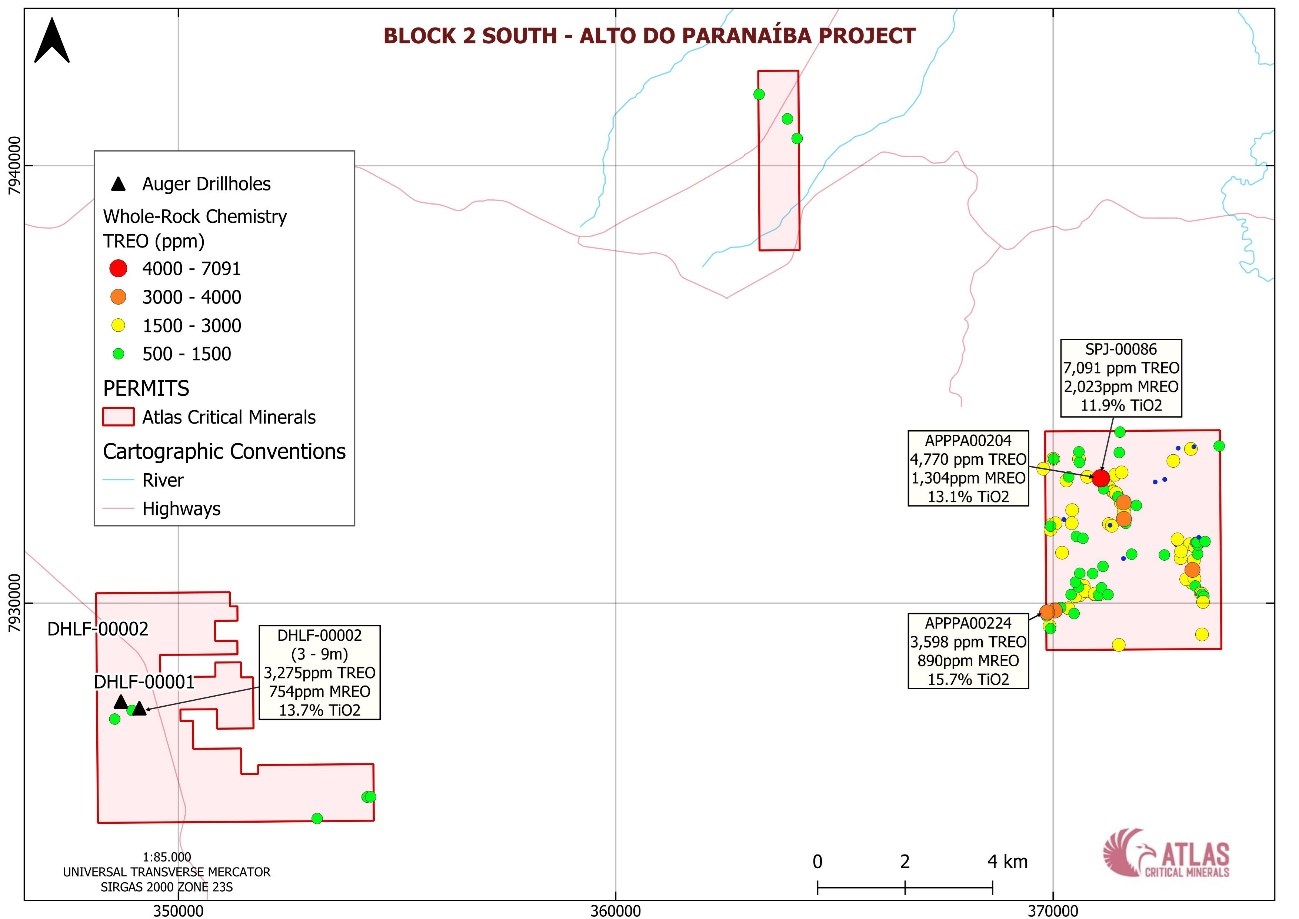
Block 2 Highlights:
- 7,091ppm TREO; 2,023 ppm MREO; 11.9% TiO2 (Sample SPJ-00086)
- 6,759 ppm TREO; 2,191 ppm MREO; 12.0% TiO2 (Sample SPJ-00069)
- 6,405 ppm TREO; 1,643 ppm MREO; 18.6% TiO2 (Sample SPJ-00008)
Figure 3 - Block 2 North Surface Sampling Results Highlighting Multiple High-Grade Zones
To view an enhanced version of this graphic, please visit:
https://images.newsfilecorp.com/files/6728/259070_cdd7d2d8b4778ada_004full.jpg
Figure 4 - Block 2 South Surface Sampling Results Showing Strong Grades in Specific Locations
To view an enhanced version of this graphic, please visit:
https://images.newsfilecorp.com/files/6728/259070_cdd7d2d8b4778ada_005full.jpg
Block 3 Highlights:
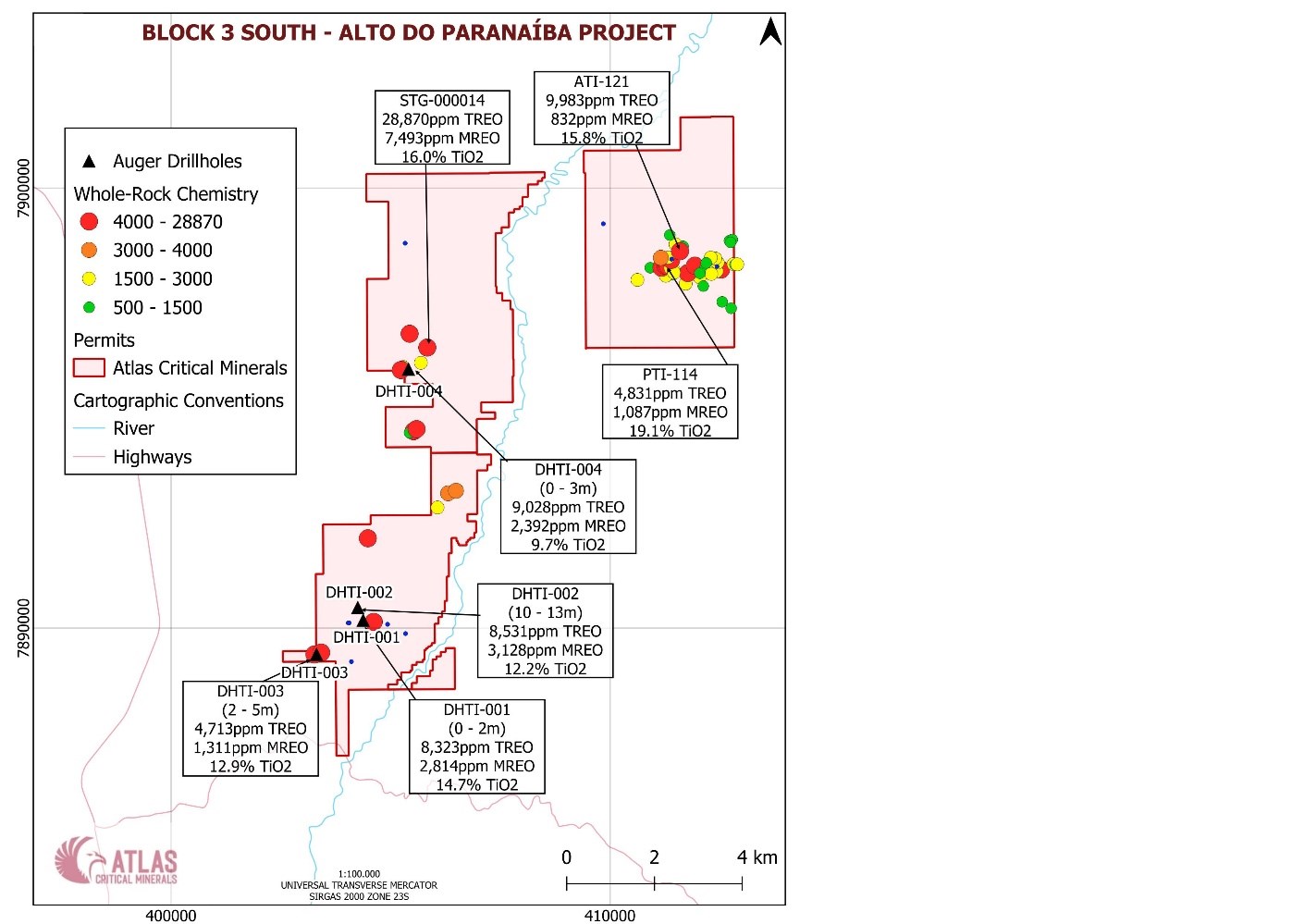
- 28,870 ppm TREO; 7,493 ppm MREO; 16.5% TiO2 (Sample STG-000014)
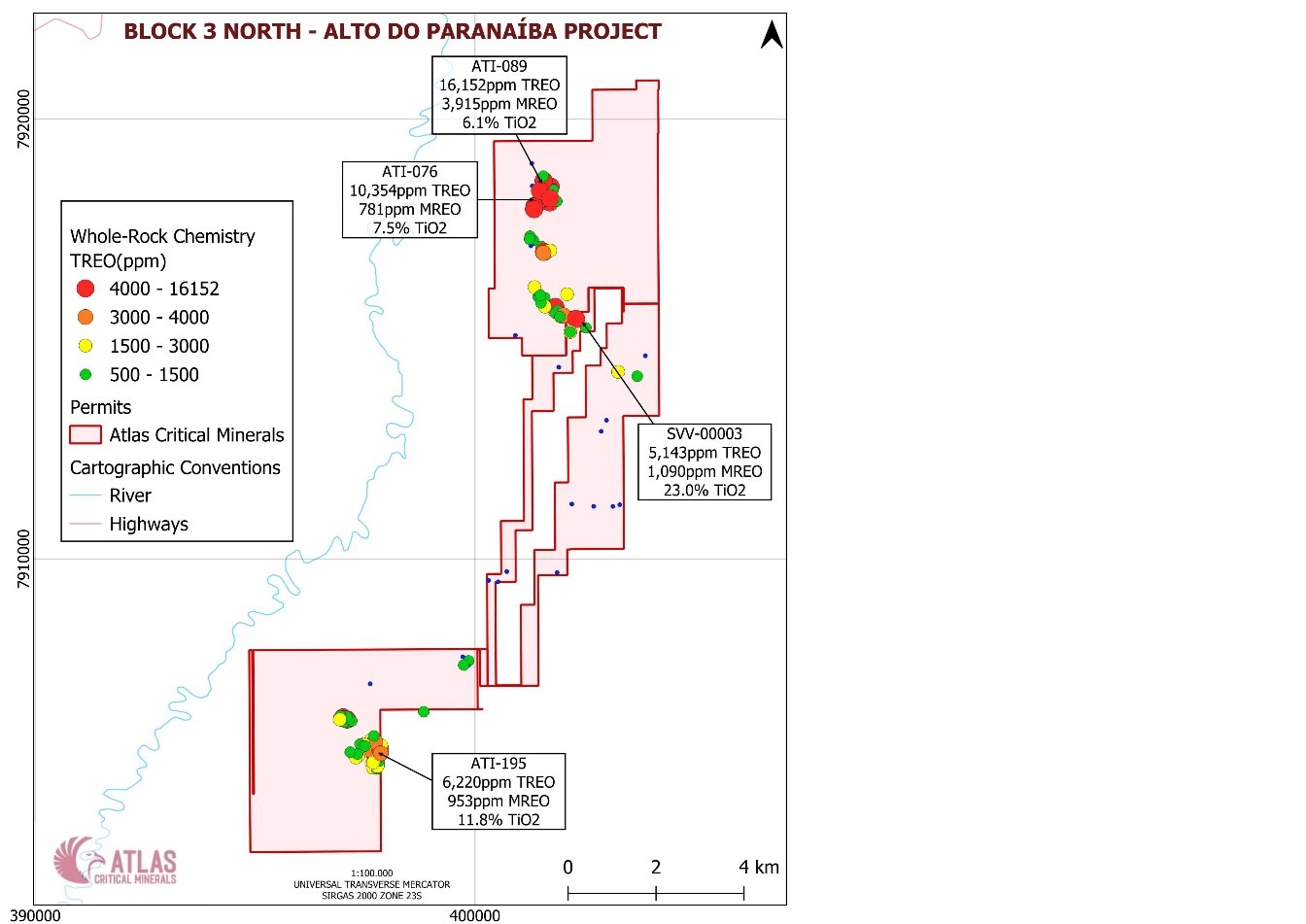
- 16,152 ppm TREO; 3,915 ppm MREO; 6.1% TiO2 (Sample ATI-089)
- 10,586 ppm TREO; 679 ppm MREO; 12.7% TiO2 (Sample ATI-025)
- 23.2% TiO2 (Sample SVV-00003)
Figure 5 - Block 3 North Surface Sampling Results Demonstrating Extensive Mineralization and Results up to 16,152 ppm TREO
To view an enhanced version of this graphic, please visit:
https://images.newsfilecorp.com/files/6728/259070_cdd7d2d8b4778ada_006full.jpg
Figure 6 - Block 3 South Surface Sampling Results Including Highest-Grade Intercepts
To view an enhanced version of this graphic, please visit:
https://images.newsfilecorp.com/files/6728/259070_cdd7d2d8b4778ada_007full.jpg
Initial Auger Drilling Campaign Delivers Strong Near-Surface Results
Initial auger drilling comprised 11 drillholes totaling 144 meters, with 178 core samples analyzed (including 22% QA/QC control samples). The drilling successfully intercepted high-grade, near-surface mineralization:
| HOLE ID | FROM | TO | LENGTH | TREO (ppm) | MREO (ppm) | TiO2 (%) |
| DHTI-001 | 0 | 21 | 21 | 5,139 | 1,391 | 13.82 |
| DHTI-001 | 0 | 12 | 12 | 5,961 | 1,690 | 13.27 |
| DHTI-001 | 0 | 3 | 3 | 7,467 | 2,452 | 13.22 |
| DHTI-001 | 7 | 12 | 4 | 5,825 | 1,446 | 16.34 |
| DHTI-002 | 4 | 13.8 | 9.8 | 6,414 | 2,091 | 12.67 |
| DHTI-002 | 8 | 13.8 | 5.8 | 7,729 | 2,681 | 12.45 |
| DHTI-002 | 11 | 13 | 2 | 8,976 | 3,396 | 11.82 |
| DHTI-003 | 0 | 7 | 7 | 4,067 | 1,090 | 11.93 |
| DHTI-004 | 0 | 6 | 6 | 7,165 | 1,968 | 11.51 |
| DHTI-004 | 0 | 3 | 3 | 9,028 | 2,393 | 9.67 |
| DHCA-00001 | 2 | 10.3 | 8.3 | 3,999 | 993 | 14.28 |
| DHCA-00001 | 6 | 10.3 | 4.3 | 4,706 | 1,124 | 15.06 |
| DHCA-00002 | 3 | 10 | 7 | 3,442 | 821 | 15.95 |
| DHCA-00003 | 2 | 8 | 6 | 3,396 | 812 | 11.21 |
| DHPM-00002 | 4 | 10 | 6 | 3,007 | 682 | 14.03 |
| DHPM-00003 | 1 | 6 | 5 | 3,129 | 716 | 13.00 |
| DHLF-00001 | 3 | 9 | 6 | 3,275 | 754 | 13.76 |
Table 1 - Significant Drilling Intercepts from the Alto do Paranaíba Project Auger Drilling Campaign
- DHTI-001: 12m @ 5,961 ppm TREO; 1,690 ppm MREO; 13.3% TiO2
- DHTI-002: 6m @ 7,729 ppm TREO; 2,680 ppm MREO; 12.5% TiO2
- DHTI-003: 3m @ 4,713 ppm TREO; 1,311 ppm MREO; 12.9% TiO2
- DHCA-00001: 4.3m @ 4,706 ppm TREO; 1,124 ppm MREO; 15.1% TiO2
- DHCA-00002: 7m @ 3,442 ppm TREO; 821 ppm MREO; 15.9% TiO2
- DHCA-00003: 6m @ 3,396 ppm TREO; 812 ppm MREO; 11.2% TiO2
- DHPM-00002: 6m @ 3,007 ppm TREO; 682 ppm MREO; 14.0% TiO2
- DHPM-00003: 5m @ 3,129 ppm TREO; 716 ppm MREO; 13.0% TiO2
- DHLF-00001: 6m @ 3,275 ppm TREO; 754 ppm MREO; 13.8% TiO2
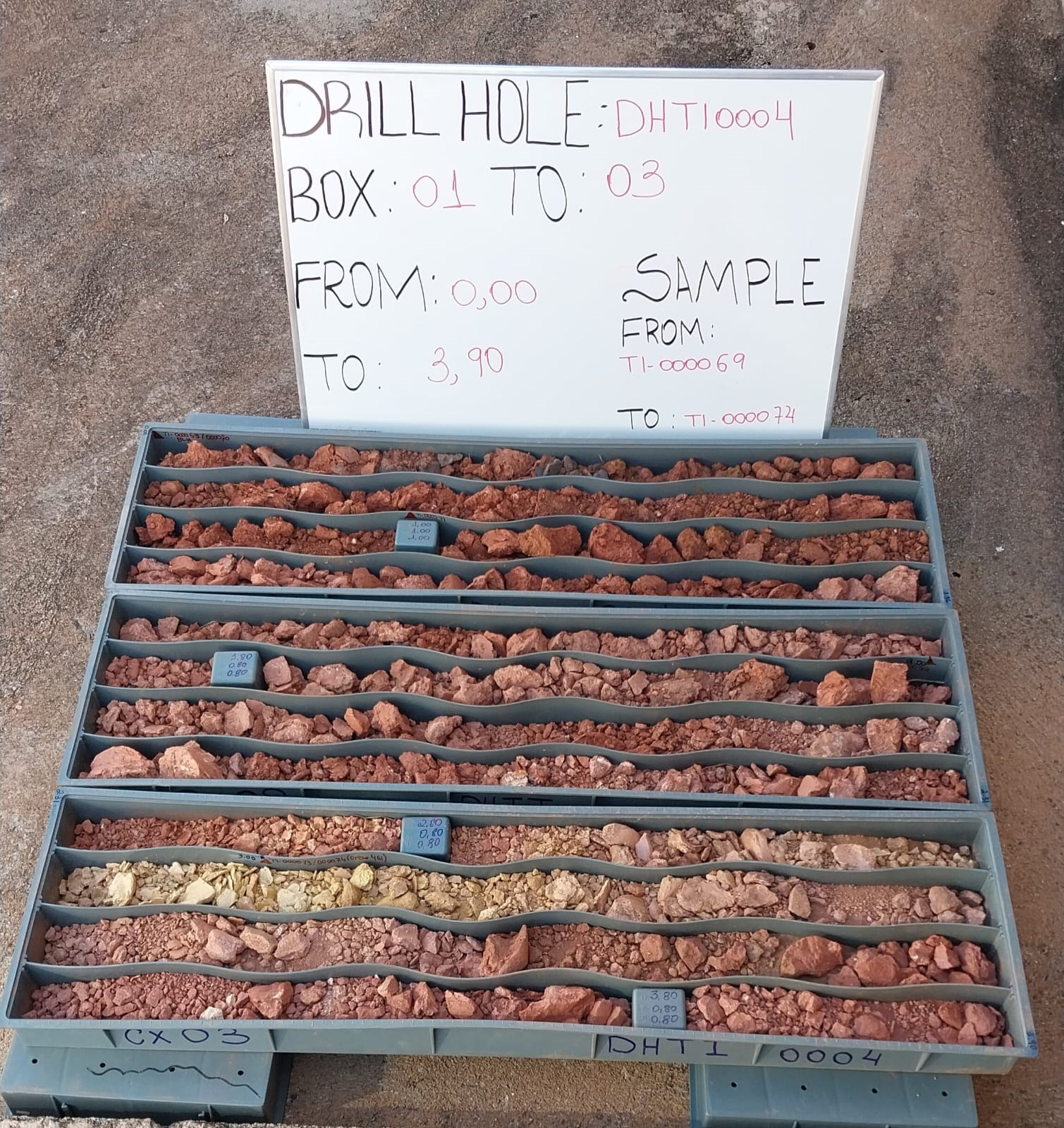
Figure 7 - Drill Core Sample DHTI-0004 (0-3.9m) Showing Clay-Hosted Mineralization with 3m @ 9,028 ppm TREO, 2,393 ppm MREO, 9.7% TiO2
To view an enhanced version of this graphic, please visit:
https://images.newsfilecorp.com/files/6728/259070_cdd7d2d8b4778ada_008full.jpg
Average TREO grades by block demonstrate consistent mineralization: Block 1 averaged 3,157 ppm TREO; Block 2 averaged 2,312 ppm TREO; and Block 3 averaged 4,906 ppm TREO. Notably, Block 3 showed high Nd+Pr averages up to 1,108ppm.
Geological Setting and Mineralization Model
The Project area benefits from intense laterization processes typical of Brazil's tropical climate, which has led to enrichment of titanium and rare earth elements within the weathered profile. The mineralized sequence occurs within extensively oxidized zones of the Mata da Corda Group, with drilling reaching maximum depths of approximately 21 meters.
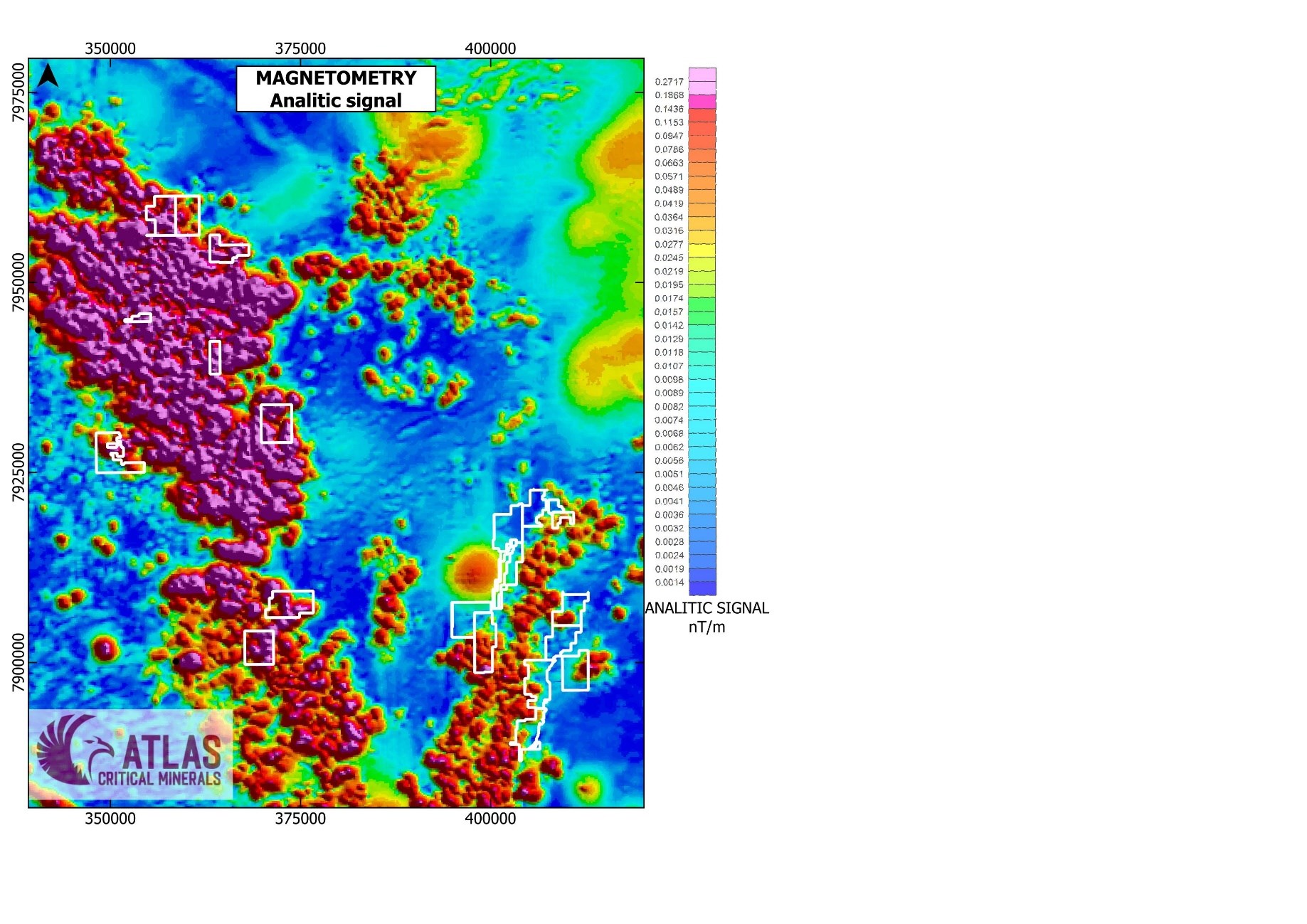
The strong positive correlation between rare earth elements and titanium, combined with the sequence's intense magnetism, makes the geological unit highly responsive to geophysical surveys, facilitating future exploration targeting.
Figure 8 - Magnetometry Analytic Signal Map Showing Strong Positive Anomalies Associated with Mata da Corda Group Mineralization
To view an enhanced version of this graphic, please visit:
https://images.newsfilecorp.com/files/6728/259070_cdd7d2d8b4778ada_009full.jpg
Quality Assurance/Quality Control
All samples were analyzed by SGS Geosol, considered to be the premier analytical laboratory in Brazil and used by major mining companies. Quality control samples, such as blanks, duplicates and standards (CRM) were inserted into each analytical batch. For all analysis methods, the average number of QA/QC represented 22% of the analytical run.
Terminology: TREO means Total Rare Earths Oxides, MREO means Magnetic Rare Earths Oxides, and TiO2 represents titanium dioxide.
About Atlas Critical Minerals Corporation
Atlas Critical Minerals Corporation (OTCQB: JUPGF) controls a large portfolio of critical mineral rights in Brazil, encompassing over 575,000 acres, and including projects in rare earths, titanium, and graphite — minerals essential for defense applications and electrification. Additionally, we own a quarry for high-quality quartzite and one of our iron ore projects is expected to start production during 2025.
Safe Harbor Statement
This press release contains forward-looking statements within the meaning of Section 27A of the Securities Act of 1933, as amended, and Section 21E of the Securities Exchange Act of 1934, as amended including the timing of commencement of the public offering and the ability of the Company to have its common stock listed on the Exchange. Forward-looking statements are based upon the current plans, estimates and projections of Atlas Critical Minerals and its subsidiaries and are subject to inherent risks and uncertainties which could cause actual results to differ from the forward-looking statements. Therefore, you should not place undue reliance on these forward-looking statements.
Risks related to the Company and its subsidiaries are discussed in the section entitled "Risk Factors" in the Company's Form 20-F filed with the Securities and Exchange Commission (the "SEC") on February 28, 2025. Please also refer to the Company's other filings with the SEC, all of which are available at www.sec.gov. In addition, any forward-looking statements represent the Company's views only as of today and should not be relied upon as representing its views as of any subsequent date. The Company explicitly disclaims any obligation to update any forward-looking statements.
Investor Relations
Brian W. Bernier
Vice President, Investor Relations
+1 (833) 661-7900
brian.bernier@atlas-cm.com
https://www.atlascriticalminerals.com/
@Atlas_Crit_Min
To view the source version of this press release, please visit https://www.newsfilecorp.com/release/259070
FAQ**
How do the observed surface sample grades of up to 28,870 ppm TREO and 23.2% TiO2 at the Alto do Paranaíba Project, as reported by Jupiter Gold Corp JUPGF, compare with historical data from similar geological settings globally?
What specific mining and processing methods does Jupiter Gold Corp JUPGF plan to employ to effectively extract and utilize the high concentrations of TREO and TiO2 found in this project?
Considering the high grades of rare earth elements and titanium indicated in the surface sampling results, what are the projected timelines for further exploration and potential development at the Alto do Paranaíba Project by Jupiter Gold Corp JUPGF?
How will Jupiter Gold Corp JUPGF ensure the sustainability and environmental protection of the Alto do Paranaíba Project while pursuing the extraction of its mineral resources, given the complexities of mining in Brazil?
**MWN-AI FAQ is based on asking OpenAI questions about Atlas Critical M (NASDAQ: JUPGF).

NASDAQ: JUPGF
JUPGF Trading
G/L:
$ Last:
0 Volume:
$ Open: